
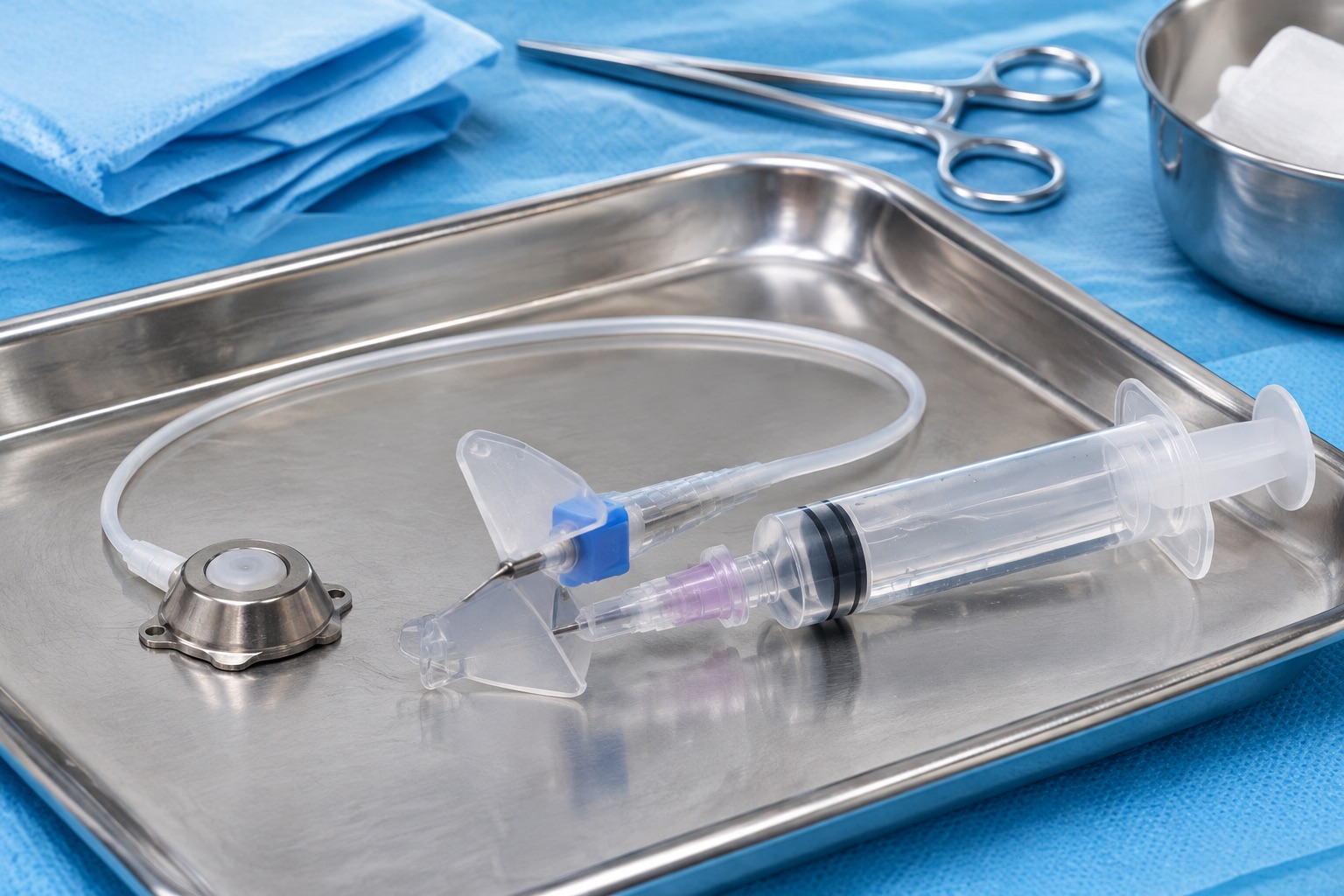
1. Celsite® Engineering Design & The Non-Coring Huber Needle Mechanism
The Celsite® Access Port System (pioneered by B. Braun Medical) represents the international gold standard in totally implantable venous access devices (TIVAD). Designed for long-term central venous administration of cytotoxic chemotherapy, total parenteral nutrition, and repeated blood sampling, the port consists of an inert biocompatible body (pure surgical-grade titanium, polysulfone, or epoxy resin) housing a self-sealing, compressed silicone elastomer septum connected to a central venous catheter terminating at the cavoatrial junction.
Accessing an implanted port mandates the exclusive use of Non-Coring Huber Needles (e.g., Surecan® Safety II). Understanding the geometry of the needle tip explains why standard hypodermic needles are strictly forbidden:
Huber Needle Geometry vs. Standard Hypodermic Bevels:
A conventional hypodermic needle possesses a straight, razor-honed beveled edge. When pushed through a silicone septum, the sharp trailing heel of the bevel acts like an apple corer, slicing out a microscopic cylinder of silicone with each puncture. Within 20 to 50 punctures, the coring creates leaks, fluid extravasation into the subcutaneous pocket, and silicone emboli entering the bloodstream.
In contrast, a Non-Coring Huber Needle features a deflected, curved tangent point with the bevel opening positioned parallel to the shaft. When inserted, the tip slices between the vulcanized silicone polymer chains, parting the silicone fibers without coring any material away. When the needle is withdrawn, the compressed silicone fibers snap back together, re-establishing an hermetic, high-pressure seal. A Celsite® silicone septum accessed exclusively with non-coring needles is validated for 2,000 to 3,000 punctures over the device’s operational lifetime.
2. Bedside Port Access: Tactile & Acoustic Confirmation
Successful port cannulation requires precise physical feedback that veteran infusion nurses rely upon for bedside placement confirmation:
The 4-Stage Bedside Access Protocol:
- Palpation & Triangulation: Using clean gloves, palpate the subcutaneous pocket to locate the three tactile retention rims of the Celsite port body. Triangulate the soft, concave center of the silicone septum between thumb and index finger.
- Skin Antisepsis: Cleanse a 10 cm circular area over the port with 2% CHG in 70% IPA using firm, cross-hatching friction for 30 seconds. Allow to dry completely for 2 full minutes.
- Three-Finger Port Stabilization: Anchor the port firmly between the thumb, index finger, and middle finger of the non-dominant hand. This prevents the port body from rolling, tilting, or slipping during needle puncture.
- Perpendicular 90-Degree Insertion: Grasp the wings of the primed Huber needle. Insert firmly at a strict 90-degree angle through the dead center of the septum. Advance smoothly through the resistance of the skin and silicone until you feel the distinct tactile "bottoming-out" sensation and feel/hear the needle tip make firm contact with the metallic titanium baseplate. NEVER tilt, angle, or rock the needle once inside the septum.
3. Patency Verification, Sluggish Blood Return & Heparin Lock
Sluggish Blood Return Diagnostic Cascade:
Immediately after needle insertion, attach a 10 mL syringe and aspirate gently. A patent port yields an immediate, brisk flashback of dark venous blood. If blood return is absent or sluggish:
- Have the patient alter position: raise their arm above their head, roll their shoulders, or take a deep breath and cough (Valsalva maneuver). This moves the catheter tip away from the vena cava vessel wall.
- Rule out Pinch-Off Syndrome: If the catheter is compressed anatomically between the first rib and clavicle, resistance occurs when the patient’s shoulder is abducted.
- If blood return remains absent, DO NOT INFUSE VESICANTS OR CHEMOTHERAPY. Instill Alteplase (Cathflo® Activase® 2 mg / 2 mL) into the port chamber to dissolve intraluminal fibrin sheaths or tails before use.
| Clinical State | Saline Flush Volume & Technique | Heparin Lock Solution | De-Accessing Clamping Sequence |
|---|---|---|---|
| Active Continuous Infusion | Flush with 10 mL 0.9% NaCl push-pause before each new medication run. | None required while actively infusing. | Change Huber needle and transparent dressing every 7 days. |
| Post-Blood Sampling or TPN | Flush with 20 mL 0.9% NaCl using ten rapid 2 mL push-pause pulses to clear residual erythrocytes and lipids. | Instill 3 to 5 mL Heparin Lock (100 USP Units/mL). | Positive-pressure clamping during final 0.5 mL of injection. |
| Dormant / De-Accessed State | Flush with 10–20 mL 0.9% NaCl prior to locking. | Instill 5 mL Heparin Lock (100 USP Units/mL) every 4 to 12 weeks. | Maintain firm downward finger pressure on port flange while withdrawing Huber needle straight upward. |