
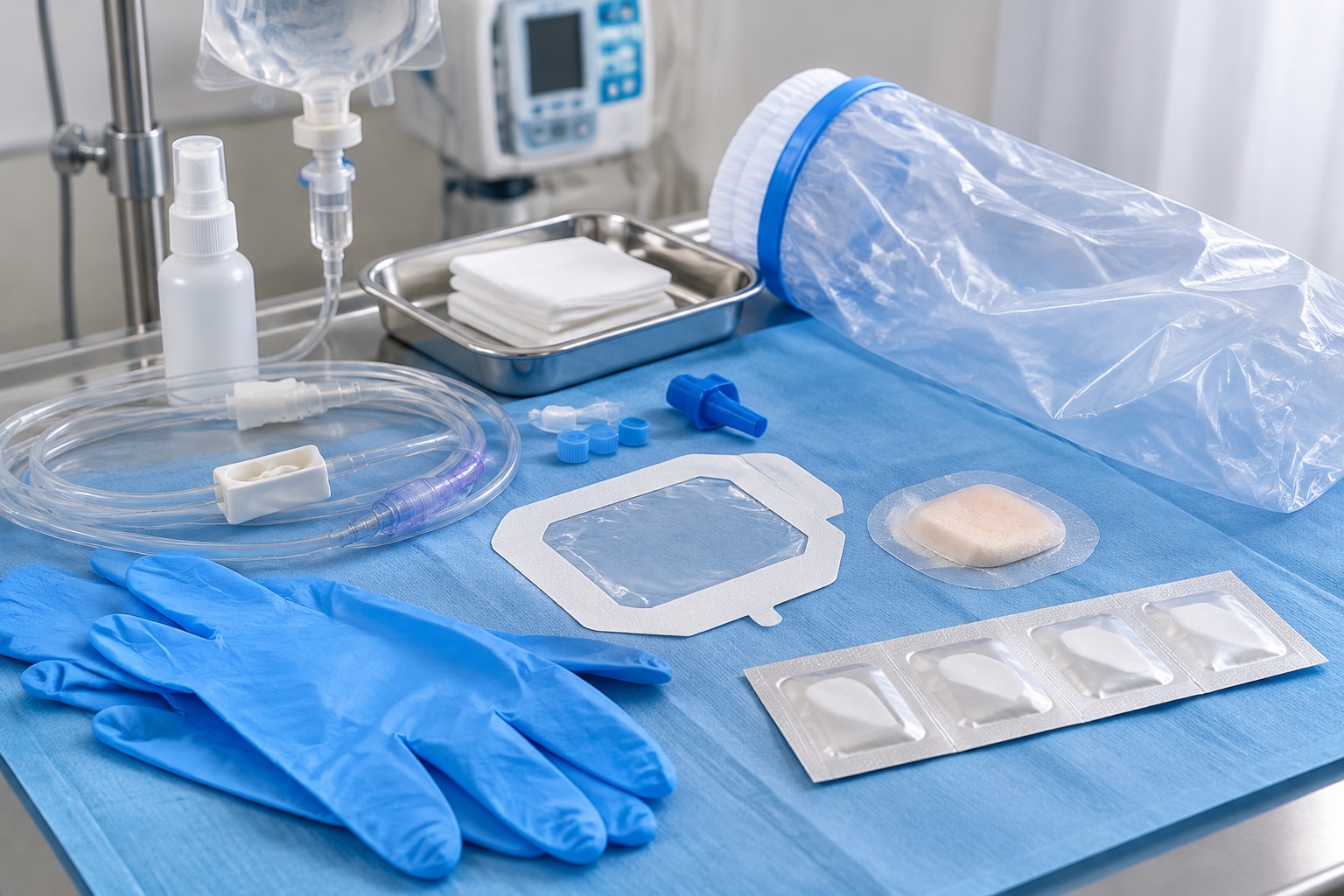
1. Sterile PICC Dressing Changes & Chlorhexidine Disk Placement
The primary defense against extraluminal bacterial migration into the central bloodstream is an intact, sterile, bordered transparent polyurethane dressing. Dressings must be changed every 7 days for transparent semipermeable dressings, every 48 hours if gauze is placed under the transparent film, or immediately if the dressing becomes damp, loosened, or soiled.
Step-by-Step Sterile Dressing Change Technique:
- Aseptic Zone & Masking: Position the patient comfortably with arm extended. Both the clinician/caregiver and the patient must wear surgical masks; have the patient turn their head away from the insertion site to prevent respiratory droplet contamination.
- Removal Toward Insertion Site: Don clean gloves. Peel the old dressing carefully by stabilizing the catheter hub with one hand and pulling the transparent film low and parallel to the skin toward the insertion site (distal to proximal). Never pull away from the site, which causes mechanical traction and catheter dislodgement.
- Skin Antisepsis (The 30s/2min Rule): Don sterile gloves. Apply a 2% Chlorhexidine Gluconate (CHG) in 70% Isopropyl Alcohol applicator wand using a vigorous back-and-forth cross-hatch friction scrub for 30 seconds over a 10 cm × 10 cm area. Allow the skin to air dry completely for at least 2 full minutes. Do not fan, blow, or blot the area.
- Biopatch Orientation (Blue Side Up): Place a chlorhexidine-impregnated sponge disk (Biopatch®) around the catheter at the skin entry point with the printed blue side facing up toward the ceiling. Placing the disk upside down prevents chlorhexidine release and leads to skin maceration.
- Engineered Securement & Dressing Application: Ensure the catheter is locked securely into an engineered stabilization device (e.g., SecurAcath® or StatLock®) to prevent pistoning. Center the transparent bordered polyurethane dressing over the insertion site, pressing the edges firmly outward to ensure an occlusive seal with zero wrinkles.
2. Syringe Barrel Physics & The Law of Laplace
One of the most dangerous and under-recognized hazards in vascular access is the utilization of small-barrel syringes. Under the Law of Laplace, the pressure generated within a fluid column is inversely proportional to the cross-sectional area of the syringe barrel:
Because of their narrow barrel diameters, standard 1 mL, 3 mL, and 5 mL syringes generate extreme hydraulic burst pressures exceeding 40 to 60+ pounds per square inch (psi) during normal manual depression. Polyurethane and silicone PICC line walls are engineered to tolerate internal pressures up to a maximum of 25 to 30 psi. Forcing fluid with a 3 mL syringe can shear the internal lumen, causing catastrophic intraluminal catheter rupture, subcutaneous extravasation, and catheter fragment embolization!
The Mandatory >=10 mL Barrel Rule & Pulsatile Flushing:
- Mandatory >=10 mL Syringe Barrel: Always administer line flushes using a syringe with a 10 mL barrel diameter or larger. A 10 mL syringe limits manual flush pressure safely below 20 psi regardless of thumb force applied. Even if only delivering 2 mL of medication, transfer the dose into a 10 mL syringe barrel before line injection.
- Pulsatile Push-Pause Flushing Mechanics: Flush the line using a "push-pause" technique: ten short, rapid 1 mL pulses separated by brief half-second pauses. Continuous laminar flushing merely streams down the dead center of the catheter lumen; pulsatile flushing generates turbulent hydrodynamic shear vortices (Reynolds numbers > 2,000) that scour viscous protein films, lipid coats, and clinging bacteria off catheter walls.
3. Showering, Moisture Protection & Daily Arm Care
Waterborne environmental pathogens (such as Pseudomonas aeruginosa, Stenotrophomonas maltophilia, and atypical mycobacteria) thrive in domestic showerheads and tap water. Getting a PICC line dressing wet is one of the leading causes of preventable catheter-related bloodstream infections in outpatients.
Waterproof Showering Rules:
- Never Submerge in Water: Immersion in bathtubs, hot tubs, swimming pools, or ocean water is strictly prohibited for the entire duration of PICC line placement. Submersion creates hydrostatic pressure gradients that force contaminated water past dressing borders.
- Commercial Waterproof Arm Sleeves: Protect the entire PICC site before showering with a validated reusable waterproof arm sleeve featuring watertight elastomeric silicone seals at both ends (e.g., DryPro® or Cast Medic®).
- Emergency Wet Dressing Protocol: If water breaches the barrier and the dressing becomes damp, moist, or peeled, do not attempt to patch or tape the old dressing. The dressing must be completely removed, the site sanitized with chlorhexidine, and a fresh sterile dressing applied within 2 hours.