
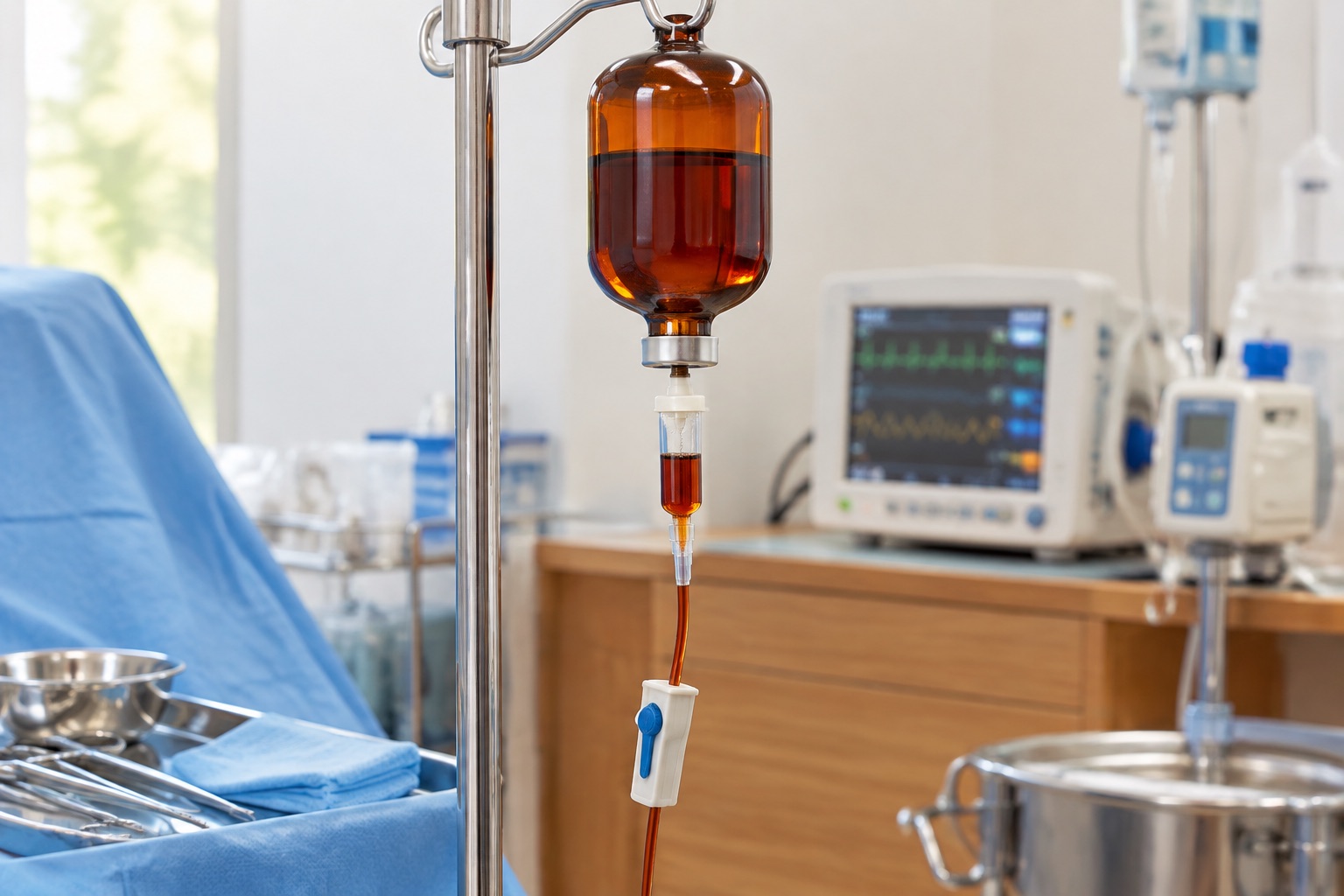
1. Intravenous Iron Nanoparticle Formulations & Carbohydrate Core Kinetics
Modern intravenous iron preparations consist of an iron oxyhydroxide core encased within an engineered carbohydrate shell. The carbohydrate matrix stabilizes the iron complex, retarding the premature release of biologically reactive, toxic non-transferrin-bound iron (NTBI / labile free iron) into the systemic circulation. Labile free iron catalyzes the Fenton reaction, generating cytotoxic hydroxyl free radicals that trigger acute vascular endothelial lipid peroxidation, systemic hypotension, and oxidative shock.
The stability of the carbohydrate shell dictates the maximum single dose, the allowable rate of infusion, and the immunogenic profile:
Pharmacokinetic Characteristics of Modern IV Iron Complexes:
- Ferric Carboxymaltose (Injectafer®): Possesses an exceptionally tight, non-dextran carbohydrate shell that virtually eliminates labile iron release. Permits high-dose rapid infusion up to 750 mg (US) or 1,000 mg (EU) over 15 minutes. Key caveat: FCM induces prolonged systemic elevations in intact Fibroblast Growth Factor 23 (FGF23), leading to renal phosphate wasting and symptomatic, protracted hypophosphatemia.
- Iron Sucrose (Venofer®): Features a semi-labile, less tightly bound sucrose matrix with a kinetic elimination half-life of 5 to 6 hours. Releases higher fractions of labile iron under rapid dosing; strictly capped at maximum single doses of 200 mg to 300 mg administered over 15 to 30 minutes to prevent transient saturation of transferrin capacity.
- Ferumoxytol (Feraheme®): A polyglucose sorbitol carboxymethyl ether-coated superparamagnetic iron oxide nanoparticle. Allows rapid 510 mg infusions over 15 minutes. Key caveat: The superparamagnetic core alters magnetic resonance imaging (MRI) scans, causing transient signal loss on T1-, T2-, and T2*-weighted sequences for up to 3 months post-infusion.
- Low-Molecular-Weight Iron Dextran (INFeD®): Enables total dose infusion (TDI) of 1,000 mg in a single sitting over 4 to 6 hours. While drastically safer than historical high-molecular-weight iron dextran (which caused fatal anaphylaxis), it requires a mandatory 25 mg test dose with a 60-minute observation period due to residual dextran-specific antibody cross-reactivity.
2. CARPA Immunology vs. True IgE-Mediated Anaphylaxis
Over 90% of acute adverse events during intravenous iron infusions are NOT true Type I IgE-mediated allergic reactions. Instead, they represent Complement Activation-Related Pseudoallergy (CARPA)—a non-allergic hypersensitivity reaction triggered by the physical interaction of carbohydrate nanoparticles with circulating pattern recognition molecules (such as C1q and mannose-binding lectin).
This interaction triggers the alternative and lectin complement pathways, generating C3a and C5a anaphylatoxins. These anaphylatoxins act directly on pulmonary and mast cell receptors, inducing transient pulmonary capillary vasodilation, back spasms, and facial flushing without systemic mast cell degranulation.
Clinical Differentiation: Self-Limiting Fishbane Reaction vs. Acute Anaphylaxis:
- The Benign "Fishbane Reaction": Characterized by sudden flushing, self-limiting mid-back stiffness, arthralgias, and chest pressure with completely stable hemodynamic parameters (normal blood pressure, normal pulse, unlabored breathing, clear lung auscultation, absence of laryngeal stridor or urticaria). Symptoms typically peak within 3 to 5 minutes of infusion initiation and resolve spontaneously within 10 to 15 minutes once the infusion is halted.
- True Life-Threatening Anaphylaxis: Rapidly progressive multi-organ compromise characterized by acute laryngeal edema (inspiratory stridor, globus sensation), diffuse expiratory wheezing, severe angioedema of the tongue/lips, widespread pruritic urticaria, and profound circulatory collapse (hypotension: systolic BP drop >30% or <90 mmHg). Demands immediate intramuscular epinephrine without delay.
3. The Diphenhydramine Paradox & Bedside Reaction Staging
DO NOT administer intravenous diphenhydramine (Benadryl) for mild, self-limiting IV iron infusion reactions. Diphenhydramine induces significant anticholinergic side effects: acute hypotension, diaphoresis, sedation, and reflex tachycardia. These pharmacological side effects mimic and worsen the clinical presentation of worsening anaphylactic shock, frequently causing panicked clinicians to initiate unnecessary resuscitation sequences and inappropriately blacklist life-saving iron therapy forever.
| Severity Grade | Clinical Presentation | Primary Bedside Interventions | Rechallenge Decision Pathway |
|---|---|---|---|
| Mild (CARPA / Fishbane) | Transient flushing, mild chest tightness, back/joint ache, nausea; stable blood pressure and pulse; clear airway. | 1. Immediately pause the infusion pump. 2. Check vital signs and auscultate lungs. 3. Reassure the patient calmly. 4. Strictly withhold antihistamines and epinephrine. |
Wait 15 minutes for complete symptom resolution. If symptoms resolve completely, resume infusion at 50% of the initial rate under continuous observation. In >90% of cases, the infusion is completed uneventfully. |
| Moderate | Persistent coughing, localized urticaria, mild periorbital edema, tachycardia (pulse >110), mild hypertension or mild transient hypotension. | 1. Cease infusion immediately. 2. Administer IV normal saline bolus (500 mL). 3. Administer IV hydrocortisone 100 mg or IV methylprednisolone 40 mg. 4. Monitor vitals q5min. |
Do NOT rechallenge on the same clinical day. Discontinue and discharge after 1 hour of stable vitals. Re-evaluate for switching to an alternative carbohydrate shell (e.g., from sucrose to carboxymaltose) with oral premedication on a subsequent day. |
| Severe / Anaphylaxis | Sudden inspiratory stridor, wheezing, profound hypotension (systolic BP <85 mmHg), loss of consciousness, facial cyanosis. | 1. IMMEDIATE INTRAMUSCULAR EPINEPHRINE: Inject Epinephrine 0.3 to 0.5 mg (1:1,000) IM into the anterolateral mid-thigh. 2. Call Hospital Code / Emergency Response Team. 3. High-flow oxygen (10–15 L/min non-rebreather). 4. Rapid IV crystalloid bolus (1,000–2,000 mL 0.9% NaCl). 5. Repeat IM epinephrine q5-15min if hypotension persists. |
ABSOLUTE CONTRAINDICATION: Rechallenge is permanently contraindicated. Patient must be documented as having life-threatening iron hypersensitivity; future anemia managed via packed red blood cell transfusions or erythropoiesis-stimulating agents. |
4. Premedication Directives & FGF23 Hypophosphatemia Vigilance
Routine prophylactic premedication with antihistamines or corticosteroids is not recommended for standard intravenous iron infusions. Large retrospective clinical registries have demonstrated that routine premedication does not decrease the incidence of genuine hypersensitivity events, but significantly increases adverse events related to diphenhydramine toxicity and steroid-induced hyperglycemia.
FGF23 Bone-Mineral Wasting & Hypophosphatemia Surveillance:
Ferric carboxymaltose uniquely inhibits the enzymatic cleavage of intact Fibroblast Growth Factor 23 (iFGF23), producing sustained elevations in circulating active FGF23. Elevated FGF23 suppresses renal proximal tubular sodium-phosphate co-transporters (NaPi-IIa and NaPi-IIc), resulting in profound, prolonged renal phosphate wasting and suppressed 1,25-dihydroxyvitamin D synthesis.
In patients receiving repeat or high-dose courses of ferric carboxymaltose (e.g., in inflammatory bowel disease, abnormal uterine bleeding, or bariatric surgery), clinicians must monitor serum phosphate levels prior to each cycle. If symptomatic hypophosphatemia develops (profound fatigue, generalized proximal muscle weakness, bone pain), switch therapy to an alternative formulation (such as iron sucrose or ferumoxytol), which does not disrupt FGF23 catabolism.
5. Ambulatory Post-Infusion Monitoring & Patient Counseling
Following completion of the intravenous iron infusion, enforce a mandatory 30-minute seated observation period in the infusion suite before discharging the patient. Delayed hypersensitivity reactions (characterized by generalized arthralgias, low-grade fever, and headache occurring 24 to 48 hours post-infusion) occur in 1% to 3% of patients.
Counsel patients that delayed aches represent benign immune-complex turnover, manage with oral acetaminophen or ibuprofen as appropriate, and educate them that transient dark or black stools are absent with intravenous iron (unlike oral iron therapy).