
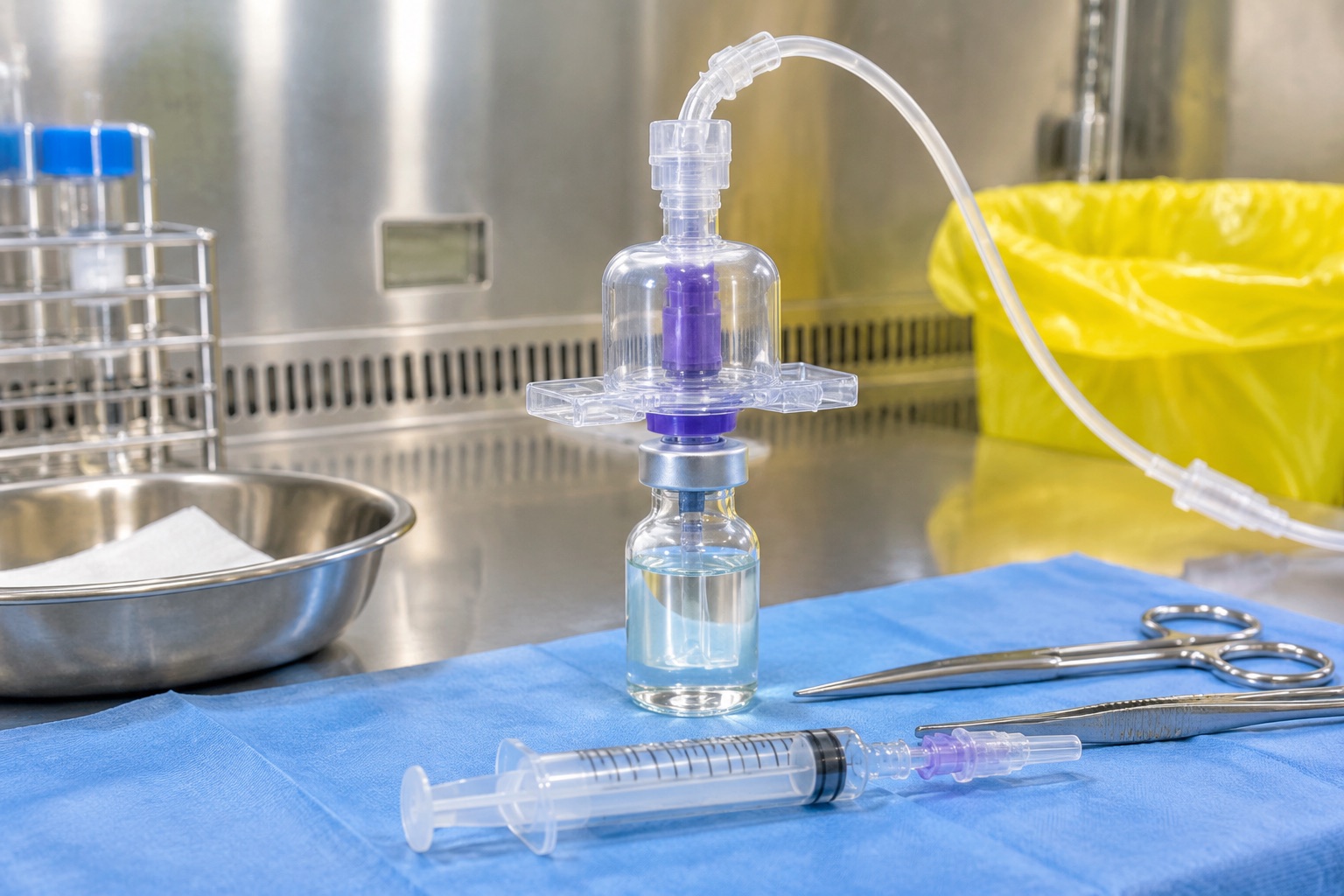
1. Cleanroom Thermodynamics & Secondary Engineering Controls (C-SEC)
USP General Chapter <800> establishes legally enforceable standards designed to protect healthcare workers from chronic, low-level occupational exposure to carcinogenic, mutagenic, and teratogenic pharmaceuticals. Handling antineoplastic agents without specialized engineering controls results in detectable urinary excretion of drug metabolites in compounding technicians and clinical nurses, accompanied by documented increases in chromosomal aberrations, spontaneous abortions, and secondary hematological malignancies.
ISO Class 7 Containment Secondary Engineering Control (C-SEC) Parameters:
- Differential Static Pressure: The negative pressure buffer room must maintain a continuous differential pressure between -0.01 and -0.03 inches of water column (in. w.c.) relative to adjacent positive-pressure anterooms. This inward airflow ensures that volatile vapors cannot escape into hallway corridors.
- Ventilation & Air Turnover: A minimum of 30 Air Changes Per Hour (ACPH) for dedicated ISO Class 7 rooms (or >=12 ACPH for Containment Segregated Compounding Areas [C-SCA]).
- Total External Exhaust: 100% of the exhaust air from the Primary Engineering Control (C-PEC; Class II Type B2 or externally vented Class II Type A2 Biological Safety Cabinet) must be vented directly through dedicated ductwork to the outside atmosphere, never recirculated into any hospital ventilation zone.
2. CSTD Engineering Taxonomy & Leakage Mechanics
| CSTD Engineering Category | Physical Pressure Equalization & Sealing Technology | Representative Commercial Devices | Clinical Strengths & Failure Modes |
|---|---|---|---|
| Physical Double-Membrane Barrier | Utilizes two elastomeric silicone membranes that mate tightly. When connected, internal non-coring needles advance through both membranes; upon withdrawal, both membranes wipe the needle tip clean and snap shut instantaneously, forming a dry-connection seal with zero liquid or vapor release. | Equashield®, BD PhaSeal™ | Strengths: Complete physical isolation of volatile antineoplastic vapors. Failure Mode: Mishandling during mating can distort the elastomeric membranes, causing micro-droplet spillage. |
| Air-Cleaning / Filter-Based Equalization | Incorporates a sterile 0.2 μm hydrophobic sterile air filter paired with an activated carbon/charcoal adsorption matrix. As fluid is injected or withdrawn from the vial, air is filtered and scrubbed of chemical vapors to neutralize internal pressure. | Tevadaptor® / OnGuard®, ChemoClave® | Strengths: Lower insertion force; familiar syringe barrel ergonomics. Failure Mode: Activated carbon can saturate under high-volume volatile compound usage; membrane can wet out if inverted improperly. |
| Closed Infusion Adapters | Dedicated dry-spike adapters and needle-free line connectors that maintain closed fluid paths throughout priming, secondary piggyback hanging, and final flush. | B. Braun Cyto-Set®, BD Texium™ | Strengths: Completely eliminates the dangerous practice of open line priming and disconnected spiked bags at the bedside. Requirement: Mandatory for all nursing antineoplastic infusions under USP <800>. |
3. Bedside Nursing Administration & PPE Directives
Under USP <800>, Closed System Drug-Transfer Devices are legally mandatory for nurses administering antineoplastic hazardous drugs. Personal Protective Equipment (PPE) requirements are strictly enforced:
Chemotherapy PPE Protocols:
- Chemotherapy-Tested Gloves (ASTM D6978): Double-gloving is mandatory. The inner glove is worn under the gown cuff; the outer glove is pulled over the gown cuff. Gloves must be changed every 30 minutes of continuous handling or immediately if contaminated or punctured.
- Protective Gowns: Polyethylene-coated, non-permeable gowns with closed fronts, long sleeves, and tight elastic cuffs. Gowns must be changed every 2 to 3 hours or immediately upon spillage.
- Surface Wipe Thresholds: USP <800> recommends routine baseline surface wipe testing with target action levels below 100 pg/cm² for cyclophosphamide, fluorouracil, and ifosfamide.